The causes and consequences of sex-differences in meiotic recombination rates and landscapes.
Meiotic recombination is a fundamental feature of sexual reproduction, with a highly conserved molecular basis and function. Yet, its rates and patterns show huge variation across eukaryotes.
This is most apparent between the sexes, with females and males frequently showing striking differences in their recombination. This heterochiasmy can be broad-scale, with differences in its strength and direction between closely related species, and it can be fine-scale, occurring within narrow genomic regions:
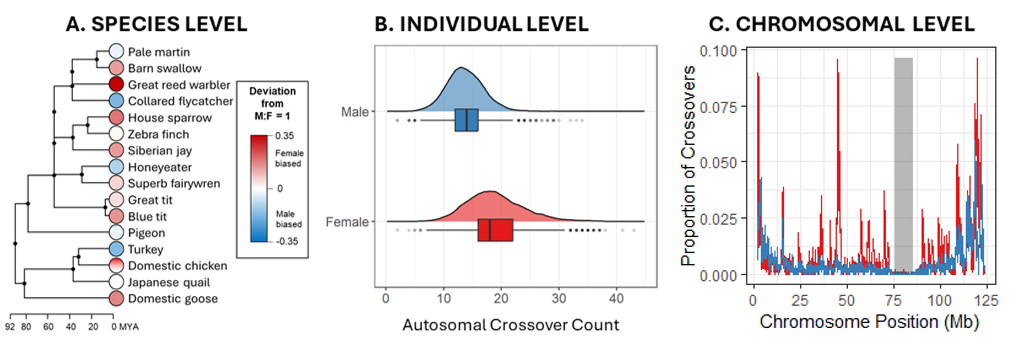
Rates and patterns of heterochiasmy shape key evolutionary processes, from direct impacts on fertility and mutation rates, to the speed of adaptation, patterns of introgression, and sex chromosome evolution.
However, despite the explosion of genomic research in recent years, we still lack a clear understanding of how heterochiasmy arises, why it evolves so quickly, and its precise consequences on each of these evolutionary processes.
Our vision is to take heterochiasmy from an evolutionary puzzle into a full picture understanding of its molecular and evolutionary causes and consequences.
The quantitative genomic architecture of fitness-related traits.

